

GAME-BASED METHOD
A combination of games and simulation approaches, which focuses on the person with his/her successes and mistakes to generate real change.

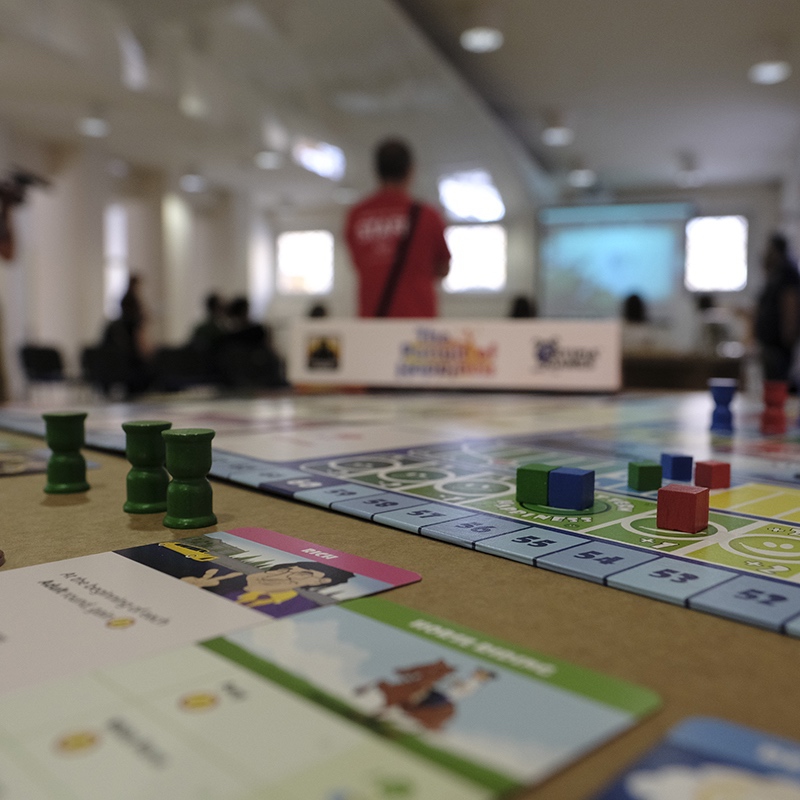 Learning is not just about acquiring new knowledge but tackling a transformation process that leads to changes in our attitudes and behaviour.
The conveying of knowledge and learning takes place actively through a game-based experience, simulating or though play, and focussing on the person with his/her attributes, successes and mistakes and on his/her fears and concerns.
Improv theatre, board games and role playing allow us to involve psycho-attitudinal skills because they leverage associations and intuitions, and they bring imagination and emotions into play. Game playing allows us to teach the rudiments of complex systems, how relational and cognitive dynamics work and to stimulate multiple types of intelligence.
And it is especially suited for rapidly changing and stressful situations.
This space is also unique, and teachers and students mix within it: they act together, both as an active part of the course.
In improvisation there is no script. “Since it can’t be repeated, an improvisation or exploration cannot be bettered, and something that cannot be bettered is, by definition, perfect”, Paolo Busi can be heard to repeat often – our improv instructor – during the lessons. Each improvisation is perfect by definition.
Game playing and improvisation also have many things in common with our life. In a game, you either win or you learn. Anyone who loses a game has the option of learning how to improve subsequent choices.
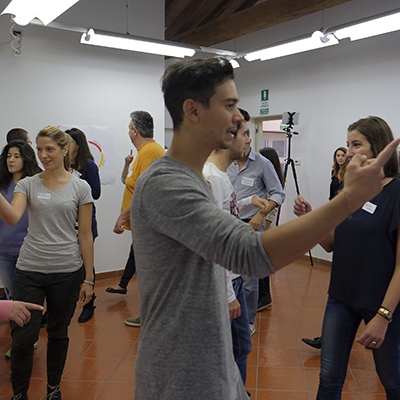 Games have increasing degrees of difficulty and overcoming each level allows us to access the next level, tackling new challenges and unexpected difficulties. Only by trying, testing and correcting our choices, can we become good; only by daring to lose can we win.
Often our mistakes are not logical, but perceptive: the game experience also allows us to improve our degree of attention, our ability to observe carefully and our capacity to perceive things correctly.
The methods used include:
- Board games
- Role play
- Improv games
- Theatre