

BACKGROUND
How Scuola di Fallimento came about: from concept and origin of its name to the building of a pioneering organisation.
 Two of the most frequently asked questions we receive are: How did the idea for the school come about? Why did you choose this name?
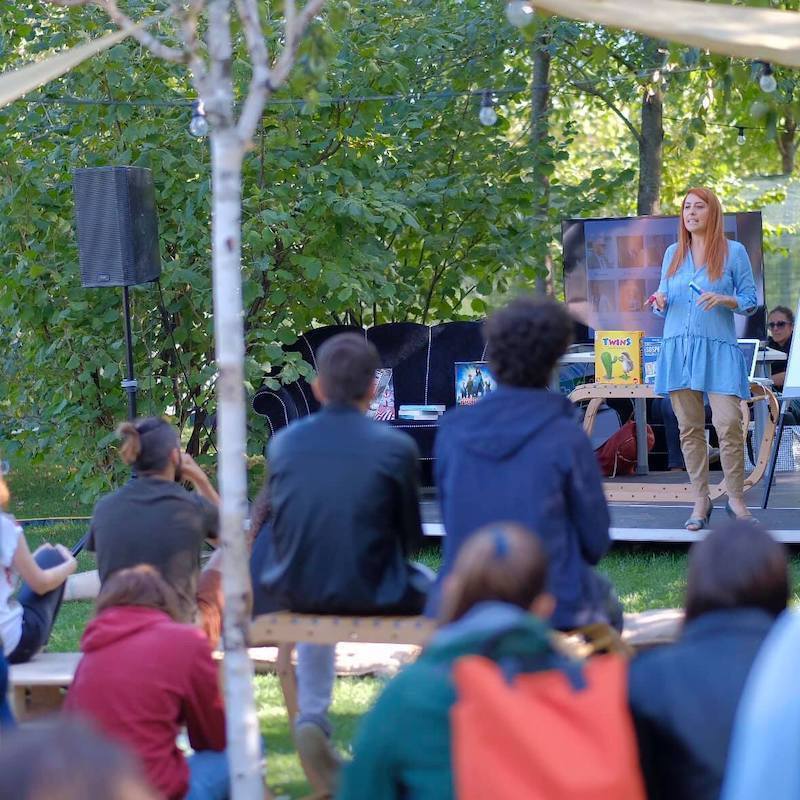
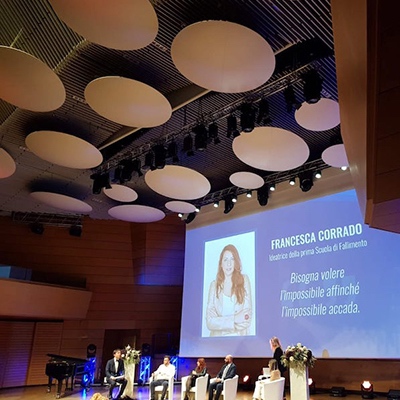
The idea for the School came about triggered by a personal reflection made by Francesca Corrado. We find the answer to these two interesting questions in her words:
“The idea came about based on my perception of error and failure, from my useless attempt to act in pursuit of perfection and, above all, from the lessons life has dealt me.
My apparent “annus horribilis” was 2015: all of a sudden, I no longer had a company, a university tenure, a boyfriend, or a home.
After mulling over this state of affairs, blaming others and blaming myself, I couldn’t see a way out, or alternative options.
And I kept wondering why everything was happening at the same time.
Meanwhile, my father’s health deteriorated; he was suffering from Alzheimer’s. And, out of necessity, I had to focus my attention not on my personal problems or, at least, not primarily on them, but on my father, the changes he was going through and the mistakes my mother, my sister and I were making while trying to take care of him. I wanted to help him, to better understand what he was experiencing and why we stop recognising those who love us. In an attempt to develop a project that could support him, I began to (re)approach studying the mind and mistakes.
And this very disease helped me understand that I was looking at my life from the wrong angle.
And so, the desire grew to question my certainties and my mistakes. But I couldn’t find any tangible tools that went beyond the simple motivational lever or a quote from some celebrity. So, I created a program that helped me and that drew on the latest research in the field of neuroscience and psychology, games and play, improvisation theatre and sport. Since it helped me, I understood that it could be a way to help others to overcome failures, too, to see them as opportunities for personal and professional growth, to regain control of our life in a low period.
I then shared my ideas with some experts and with my Play Res partners that took my thinking onboard and, from there, transition to the idea of a School was a short step.
We launched a social media campaign and produced a video thanks to the support of 3 professionals who appreciated and believed in the project right from the start: Jacopo Ziliotto designer, Stefano Corradi musician and Fabio Ardu speaker.
You can read the rest of the story on this website.
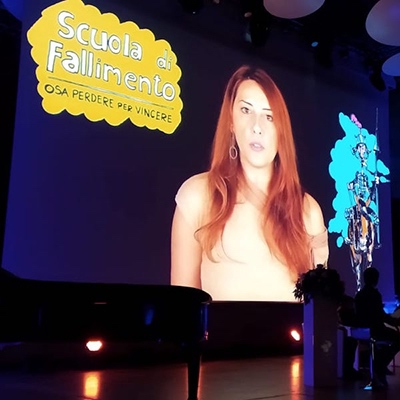
 A lot of discussion was given to the choice of name for the School. I’ve always thought that it was necessary in some way to debunk the word failure, because failure is seen as an indelible mark and error is considered an invalidating social stigma. For us, personal or business failure, although it is a painful experience, can be a new springboard and we wanted to express this concept starting from the name and the use of an airplane as a visual device identifying the School. Failure as a journey for discovering ourselves, our limits and our talents.
Our pay-off – which is also a motto – is: “dare to lose to win”; losing is part of the game and to win, it’s necessary to accept and reflect on this possibility.
Dare to lose to win is also a strategy in the literal sense of the term: it’s a long-term action plan. It’s difficult for us to be brave enough to take the leap and risk, to accept failure and the fear of failure, but it is also difficult to accept that we are fallible because we cannot always win.
In games, as in life, sometimes we win sometimes we learn and, through practice and training, thanks to this strategy, the results which can be achieved are unimaginable”.
 The School includes among its main objectives that of building a healthy culture of failure, increasing the degree of acceptance of failure, the ability to analyse and awareness that failure is a natural and essential part of the game.
We have therefore chosen to highlight this purpose using colour combinations representing openness to what’s different and what’s unconventional, the inclusion of different points of view and ideas, and in our logo featuring an airplane. The airplane is connected to the symbolism of flight, made up of ascents and descents, and why not, even acrobatics!
The plane is also linked to the archetype of travel: travel as the discovery of new worlds, new perspectives, new abilities and new opportunities.
It represents the air and the sky reflecting the world of ideas and projects, some of which take flight, and the higher you fly the greater the fear of failure, while others fail to even get off the ground.
But we must be bold and dare despite fear and accept failure as a possibility for improvement and learning, just like Lucky, the little seagull.
The seagull escaped beating her wings frantically until she flew over the port cranes, the boat masts, and immediately afterwards, she glided back, circling around the church tower several times.
“Flying! Zorba! I can fly!” she screeched euphorically from the vast grey sky.
The human stroked the cat’s back.
– Well, cat. We did it – he said sighing
– Yes, on the edge of the abyss, she understood the most important thing – Zorba meowed
– Oh yes? And what did she understand? – asked the human
– Only those who dare to fly, actually fly – Zorba meowed.
This story of Lucky and Zorba was written by Luis Sepúlveda but there are many others. Actual people who understood what was really important only by making mistakes.